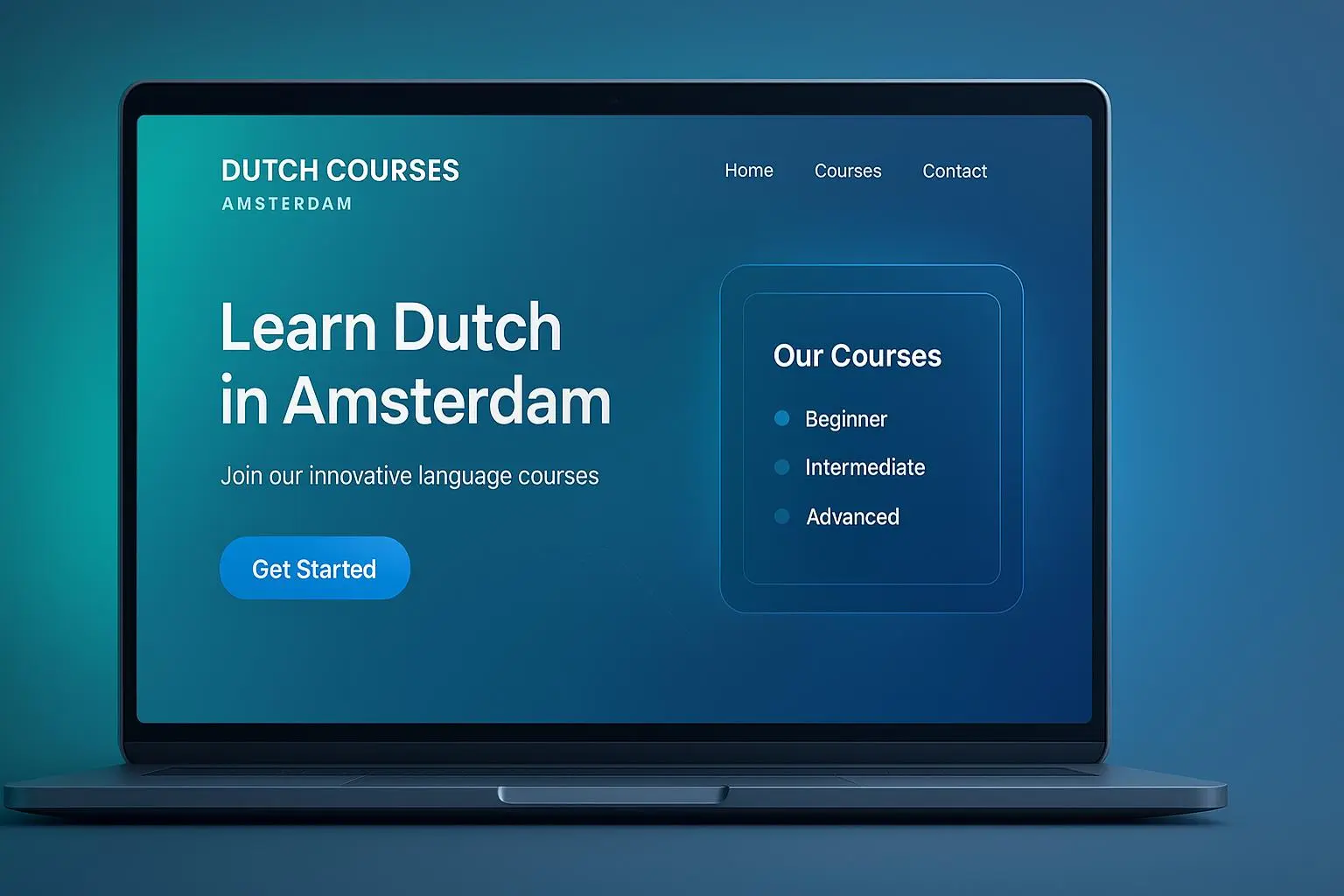
Ultimate Guide: Dutch Courses Amsterdam
Aug 22, 2026 • 8 min
If you live in Amsterdam and want to stop being "that expat who only speaks English," this guide is for you.
I'll walk you through what Dutch Courses Amsterdam (DCA) actually offers, why it matters, and how to fold Dutch practice into a busy life—work, commute, kids, whatever your schedule looks like. No fluff. Concrete routines, real pitfalls, and a handful of advanced tips that actually help when you hit B1 and beyond.
Why learn Dutch in Amsterdam at all?
Short answer: you can get by in English, but Dutch opens doors.
- Jobs: In many local companies, Dutch is still the default in meetings and client work. Being able to hold a meeting in Dutch changes your chances for promotion.
- Integration: Knowing the language makes registering for services, understanding municipal letters, and joining neighborhood groups simpler.
- Daily life: It’s easier to make friends, order at the market, and feel less like a tourist.
Statistics back this: language proficiency correlates with better labour market outcomes for migrants in the Netherlands[1]. And from a personal standpoint, small language gains reduce isolation more than you’d expect.
What DCA does differently (the core features)
Here’s what sets Dutch Courses Amsterdam apart from a generic evening class.
- Small group classes. Smaller groups mean more speaking time per student. You’ll speak in every session—not just when the teacher asks.
- Specialized teachers. Instructors focus on practical communication: forms you’ll actually fill out, meetings you’ll be in, and the "language intuition" that textbooks miss.
- Free online vocabulary tool. Use it between lessons for spaced repetition. It’s designed to sync with course modules so you review exact words you learned that week.
- Modules for real needs. Business Dutch, daily life, NT2 exam prep, and bureaucratic Dutch are split into modules so you don’t waste time on irrelevant stuff.
- Hybrid model. In-person conversation labs plus asynchronous grammar and listening exercises let you learn on the tram or during lunch.
Those features aren't marketing speak—they're the difference between getting a certificate and actually being able to use Dutch at work or in the grocery store.
How to fit Dutch study into a real Amsterdam life
If you work 40+ hours a week, the biggest challenge isn’t grammar; it’s time.
Here’s a practical weekly plan that’s realistic for busy people:
- 2×90 minute group classes per week (in-person): core instruction, role plays, feedback.
- 3×20 minutes on the vocabulary tool (commute or lunch): spaced repetition, 150–200 words/month target.
- 1×60 minute conversation lab or tandem meetup (café): unstructured talk, mistakes allowed.
- 1×30 minute media session (podcast/TV): listening to natural speech.
Doable? Yes. Effective? Also yes—active recall plus social practice beats cramming grammar sheets.
Small aside I still remember: I once used a 25-minute tram ride to drill verb conjugations on an Anki deck. Two months later, a colleague asked me a question in Dutch and I answered without thinking. That commute felt like paid study.
How DCA prepares you for the NT2 and real-world use
Many students come with a goal: pass the NT2 exam for residency or work. DCA’s modules tend to align with NT2 competencies (reading, writing, listening, speaking), but they also include real-world tasks: writing municipal forms, composing professional emails, and practicing short presentations.
If you’re aiming for B1 within six months, prioritize:
- Intensive track (if you can commit full-time).
- Weekly writing workshops.
- Phonetics sessions for pronunciation confidence.
People who combine course work with targeted practice—specifically speaking and writing under timed conditions—tend to pass the exam faster.
A real story: what actually worked for me
When I moved to Amsterdam, my spoken Dutch was at kindergarten level—basic greetings, numbers, and chips/fries vocabulary. I enrolled in a weekday intensive at a local course provider (not DCA at first), then switched to DCA’s hybrid program because I needed more flexible listening and vocabulary reinforcement.
What I did:
- Attended 3 in-person modules per week for three months.
- Used the course’s vocabulary tool daily for 15–25 minutes (commute time).
- Joined weekly tandem meetups at a café where we committed to 40 minutes Dutch, 20 minutes English.
- Took one phonetics workshop focused on the 'G' sound.
Outcome after six months:
- Passed B1-level workplace conversations comfortably.
- Was able to read and respond to municipal emails with minimal translation.
- Got my first team lead meeting where I could contribute in Dutch rather than nodding and letting someone else translate.
What mattered: consistency and social pressure. The tandem group called me out when I slipped back into English. That little bit of accountability was more effective than any solo study streak.
Micro-moment: one tiny detail that stuck with me
At the first tandem meetup, the host brought small pastries labeled in Dutch. Reading the labels—without translating—was the first tiny win. It made the language feel domestic and not just exam practice.
Common sticking points and how DCA helps
- The guttural 'G'. DCA runs targeted phonetics workshops. One focused hour can change your confidence a lot.
- People switching to English. Practice short, scripted interactions: ordering coffee, asking for directions, or paying at the market. Stick to Dutch until you hear English back.
- Bureaucratic Dutch. Take a module on municipal forms. It’s jargon-heavy and worth the extra class.
- Pronouns and word order. Drill with timed sentences and immediate correction in class. That beats passive study.
Students who pair classroom correction with daily active recall (Anki or course vocab tool) retain grammar and vocabulary much better[2].
Advanced tips when you reach B1+
When you hit B1-B2, learning shifts from "how" to "why"—why native speakers use certain phrases, and how to sound natural.
- Shadowing: Listen to a short Dutch clip, then speak along with it, matching rhythm and intonation.
- Media diet: Swap one evening of Netflix for NPO Start or Dutch podcasts. Even 30 minutes per week helps.
- Industry vocab: If you work in finance, tech, or healthcare, request a module that focuses on sector-specific language. It pays off in meetings.
- Teaching back: Explain a grammar point to a novice. Teaching forces you to organize knowledge and exposes gaps.
- Read municipal and workplace documents aloud. It makes passive vocabulary active.
These approaches move you from "I can survive in Dutch" to "I can thrive in Dutch."
Who benefits most from DCA?
- Expats and international students who need practical Dutch fast.
- Professionals aiming for client-facing roles or promotions.
- Long-term residents preparing for integration exams and bureaucracy.
- Cultural enthusiasts who want to understand Dutch media, literature, and humor.
There are sensible contrarian takes: if you plan to only work in English within a global company and don’t intend to stay long-term, deep investment in Dutch might be low priority. But even a B1 makes day-to-day life easier and signals commitment to local employers.
Tools that actually help alongside DCA
- Anki or the DCA vocabulary tool: for spaced repetition.
- Memrise or native-speaker video resources: for listening nuance.
- iTalki: if you need extra one-on-one conversation practice outside class.
- Van Dale dictionary: indispensable for advanced learners.
Use the course’s vocab platform as the spine, then add one or two apps for variety.
Cost and ROI: is it worth it?
Dutch Courses Amsterdam isn’t the cheapest option, but it’s not expensive relative to the outcomes.
Think of it this way:
- Short-term cost: a few hundred euros per module.
- Return: better job chances, less reliance on translators, fewer mistakes on official forms, and faster social integration.
For professionals I know, passing C1 directly affected promotions—and the payback was within a year. For students, it often opens internships and part-time roles that require Dutch.
If budget is tight, combine municipal or free resources with DCA’s modular classes rather than a full intensive track.
Final checklist: how to choose the right DCA path
- Goal: NT2 exam? Choose the intensive module with weekly writing workshops.
- Time: Busy schedule? Pick hybrid modules and the micro-learning commute plan.
- Need: Bureaucracy help? Take a municipal-forms module.
- Pronunciation trouble? Sign up for the phonetics workshop early.
- Career-focused? Ask for business-Dutch role plays and sector vocab.
Ask the provider for a sample lesson and a module map. If they can show you what you’ll learn week-by-week, that’s a good sign.
Closing thought
Learning Dutch in Amsterdam isn’t a quick hack—it’s a steady investment. But if you pick a program that prioritizes speaking, gives you tools to practice between lessons, and forces you into social situations where mistakes are okay, you’ll progress faster than you expect.
And the first time someone thanks you in Dutch for helping them with a small thing—registering, filling a form, or giving directions—you’ll know it was worth the effort.
References
Footnotes
-
Centraal Bureau voor de Statistiek (CBS). (2022). Labour Market Participation and Language Skills of Migrants in the Netherlands. Retrieved from https://www.cbs.nl/en-nl/publication/2022/45/labour-market-participation-and-language-skills-of-migrants-in-the-netherlands ↩
-
Roediger, H. L., & Karpicke, J. D. (2006). Test-Enhanced Learning: Taking Memory Tests Improves Long-Term Retention. Psychological Science, 17(3), 249-255. Retrieved from https://doi.org/10.1111/j.1467-9280.2006.01693.x ↩