The Private Momentum Kit: Track Progress Without Performance Pressure
Aug 25, 2026 • 9 min
If you've ever felt your tracker, leaderboard, or "streak" doing more harm than good, you're not alone.
Most modern tracking systems are built for visibility—likes, badges, leaderboards. They work great when you want to gamify a team or boost engagement. But for individual growth, especially work, creativity, and wellbeing, that spotlight often becomes a pressure cooker.
The Private Momentum Kit (PMK) is the opposite of that: a privacy-first, low-drama way to capture proof of progress. It helps you notice momentum without inviting comparison, performance anxiety, or metric addiction.
This post explains the why, the what, and the how—templates included—so you can try the 7-day Clean-Plate Experiment and decide for yourself.
Why public metrics backfire (short version)
Social rewards are powerful. They also reroute your motivation.
When progress is public, the brain starts optimizing for applause, not mastery. You chase visible wins because they're easier to notice and share. That changes what you care about and raises your anxiety: miss a public target and the embarrassment stings harder than a private miss.
Research in motivation tells the same story: external rewards can undermine intrinsic drive. In plain terms, when you track for other people, you stop tracking for yourself[1][2].
So if you want long-term growth, you need a system that keeps your focus on the process—the things you actually control—without turning everything into a performance for an audience.
What the Private Momentum Kit actually is
PMK is three simple things, done privately and consistently:
- Micro-evidence and micro-journals: short, qualitative entries that prove you showed up.
- Private micro-badges: tiny, personal rewards that feel good but stay private.
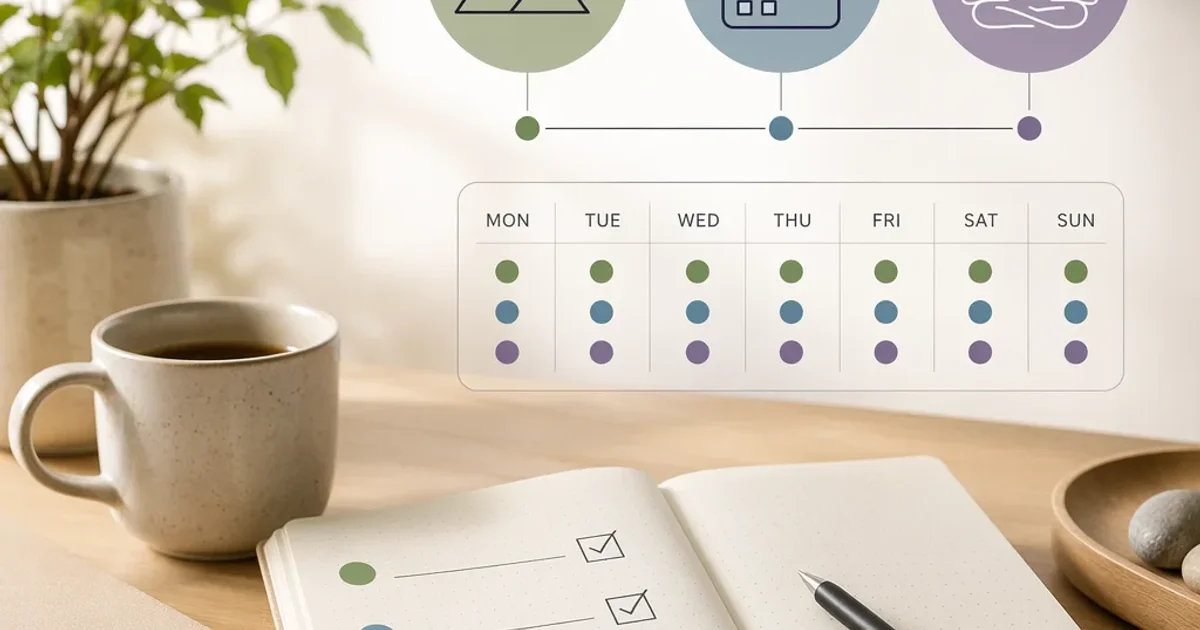
- A Three-Signal Dashboard: three minimal, private signals—Leading, Consistency, Wellbeing.
That's it. No public leaderboards. No follower-cooked metrics. No vanity stats.
Each piece is small by design. The point isn’t to complexity-optimize your life. It’s to reduce friction for noticing momentum so you keep going when the outcome is still a way off.
How I actually made this work (a real story)
Two years ago I slipped into a habit that should have been empowering: tracking my mornings. I logged meditation, walking, writing, and reading into an app that cheerfully flashed a streak counter and let me share achievements.
It started great. But after a month I noticed something odd: my journaling felt performative. I would sit, thinking about the screenshot I might take, not the sentence I wanted to write. I missed days not because I wasn't doing the work but because I was scared to break the streak publicly.
So I ripped everything out. For one week I hid all sharing options, silenced app notifications, and moved my habit logging to a tiny pocket notebook. Each morning I wrote one line of micro-evidence: "15m writing—finished scene," or "walked 20 min—felt clearer."
By day four the urge to post disappeared. By day seven my output was steadier and less anxious. I still had proof of progress—a notebook of short wins—but the wins were mine. No likes, no commentary, just a quiet sense of forward movement.
The unexpected result? Over three months I produced more drafts and felt less burnout than the prior three months when I tracked publicly. The private system didn't make me lazier; it made the practice sustainable.
The three components, explained
Micro-evidence & micro-journal (what to write)
Micro-evidence is tiny, concrete proof that you did the work. It’s not a goal statement or a to-do. It’s evidence.
Examples:
- "Wrote 450 words; pushed past scene logjam."
- "Called two leads; got one voicemail."
- "Meditated 10 minutes; noticed tension in shoulders."
Make entries no longer than two sentences. Use past tense. Keep them private—analog notebook, encrypted app, or a local-file system like Obsidian.
Why this works: small, real entries give you a record that’s easy to review and emotionally scaled to your day. They stop the "all-or-nothing" thinking ("I didn't hit the metric so nothing counts") because they prove consistent effort.
A template to try:
- Date | Micro-evidence (one line) | Quick note (what helped / what blocked) | Signal markers (see dashboard)
Private micro-badges (how to reward yourself without a crowd)
Badges and gamification can work internally if they're low-stakes and private.
Make a tiny set of badges—3 to 5 at most—and keep them private. Examples:
- "First Draft" sticker for any 1,000-word session
- "Deep Focus" star for 60 minutes uninterrupted work
- "Reset" badge for a day you recovered gracefully from burnout
Physical badges are great: gold star stickers on your notebook, a colored paperclip, a wax seal on an envelope. Digital badges work too if they’re locked behind a password or stored locally.
The trick: badges are cues for self-recognition, not status. Treat them like a small ritual. I promise the odd paper sticker can be surprisingly motivating.
Quick aside (micro-moment): one day I awarded myself a tiny washi sticker for doing laundry between writing sprints. It felt ridiculous until the sticker sat on my page and reminded me that life and work both mattered. That tiny sticker lasted two months.
The Three-Signal Dashboard (what to track, simply)
Track only these three signals. No more.
- Leading Indicator (Effort)
- The high-leverage action for your goal. Examples: words written, sales calls, practice sessions.
- Binary or small-number counts (yes/no or 0–3).
- Consistency (Frequency)
- How many days this week you showed up for the leading action.
- Simple tally or checkboxes.
- Wellbeing (Sustainability)
- One quick measure of mental/physical state: 1–5 mood, sleep quality, or stress level.
- This prevents the system from encouraging burnout.
Each day you log a micro-evidence entry and tick these three signals privately. The goal: the dashboard shows momentum even when outcomes haven't matured.
Example daily line:
- 2023-11-12 | Wrote 600w (Leading: yes) | Consistency: 4/7 | Wellbeing: 4/5
If that looks boring, good. Momentum often is.
The 7‑Day Clean-Plate Experiment (a step-by-step plan)
If you're curious and overwhelmed by your current tracking setup, try this.
Day 0: preparation
- Pick one leading indicator (the one action that moves your goal forward).
- Decide how you'll capture micro-evidence (notebook, encrypted app, Obsidian).
- Pick three micro-badges (optional).
Days 1–7: clean plate
- Mute or hide all public stats: social feeds, shared streaks, health app leaderboards.
- Every day, write one micro-evidence entry (one or two lines).
- Update your three-signal dashboard (binary + tally + wellbeing).
- If you hit the action, consider awarding a private micro-badge the same day.
- At the end of each day, close your notebook and don’t post anything.
Day 8: reflect
- Review your private week. How many leading-action days? How's consistency? Did wellbeing improve?
- Ask: Did anxiety around performance decrease? Did the process feel more meaningful?
The aim is not perfection. It’s awareness. You might discover you worked more quietly but more often. That’s momentum.
Templates you can copy
Micro-journal page (daily)
- Date:
- Micro-evidence (1–2 lines):
- Leading: Y/N
- Consistency this week: X/7
- Wellbeing (1–5):
- Quick note (what helped/blocked):
Weekly review
- Total leading days:
- Average wellbeing:
- Biggest win:
- One change next week:
Badge list (physical or private)
- Deep Focus: 60 uninterrupted minutes (paper star)
- First Draft: 1,000 words in a day (colored tab)
- Reset: recovered after a missed day (silver dot)
If you use Obsidian or Notion, make a template with those fields and a weekly roll-up. If analog, use a small notebook and three colored pens.
When the PMK is not the answer
Public accountability can be useful. Some people thrive under external pressure—sales teams, deadlines, or group challenges. PMK isn’t a universal cure.
Use PMK when:
- You feel anxious about public metrics.
- You’re doing creative work where quality lags quantity.
- You want sustainable habits rather than quick spikes.
Avoid PMK if:
- Your role requires public transparency (team metrics, stakeholder reporting).
- You lack intrinsic motivation and need external structure to start. Consider a hybrid: PMK for practice, public goals for verification.
How PMK changes the conversation about "success"
Most tracking flips the timeline: outcomes first, process later. PMK flips it back.
You focus on leading actions you control, mark consistency, and watch wellbeing. Outcomes follow, but they aren’t the only proof you’re moving forward.
This is subtle but powerful. Instead of celebrating only epic wins, you keep a ledger of small momentum. Over months, those micro-evidence entries form a believable narrative of growth—one you don’t have to defend to anyone.
Common objections, answered briefly
- "Won’t I lose motivation without public praise?" Some will. But many switch from extrinsic to intrinsic motivation and sustain practice longer. Test it with the 7-day experiment.
- "Private badges feel childish." Maybe. They work because they create tiny rituals. If a sticker helps you write more drafts over three months, joke or not, it delivered.
- "How do I measure real progress?" Use lagging indicators occasionally—monthly or quarterly—but keep day-to-day focus on leading signals.
How to know if it’s working
After four weeks, ask:
- Are you doing the leading action more consistently?
- Is your average wellbeing better or worse?
- Do you feel less anxious about missing a day?
If yes, PMK is helping. If no, tweak your leading indicator or the journaling habit—maybe switch digital tools or simplify the signals.
Tools I recommend (quick)
- Analog: A pocket notebook + three colored pens (simple and offline).
- Obsidian: Local-first micro-journals and templates.
- Day One: Encrypted micro-journaling with metadata.
- Streaks: Private habit tracking (iOS) if you want minimalist visuals.
Use one tool only. Stop switching. The point is simplicity.
Final thought (tiny pep talk)
You build momentum by noticing small moves and protecting them from performance pressure.
The Private Momentum Kit is not a magic bullet. It is a permission slip: permission to do the work quietly, to count small wins, and to make your progress about you again.
Try the 7-day Clean-Plate Experiment. If nothing else, it will show you how much of your busyness was really for an audience—and how much you were quietly accomplishing anyway.
References
Footnotes
-
Edward L. Deci & Richard M. Ryan. (1985). Intrinsic motivation and self-determination in human behavior. Retrieved from https://doi.org/10.1016/B978-0-306-42026-6.50006-5 ↩
-
Albert Bandura. (1977). Self-efficacy: Toward a unifying theory of behavioral change. Retrieved from https://doi.org/10.1037/0033-295X.84.2.191 ↩