Identity Micro-Rituals: 8 Tiny Actions That Convince Your Brain You’re ‘Already’ That Person
Aug 24, 2026 • 9 min
You want to be a morning person, a thoughtful leader, a disciplined investor—or maybe just someone who doesn’t scream at their inbox by 9am.
The usual advice feels like renovation: demo the whole house, pick tiles, and pray you’ll like the outcome. It rarely works.
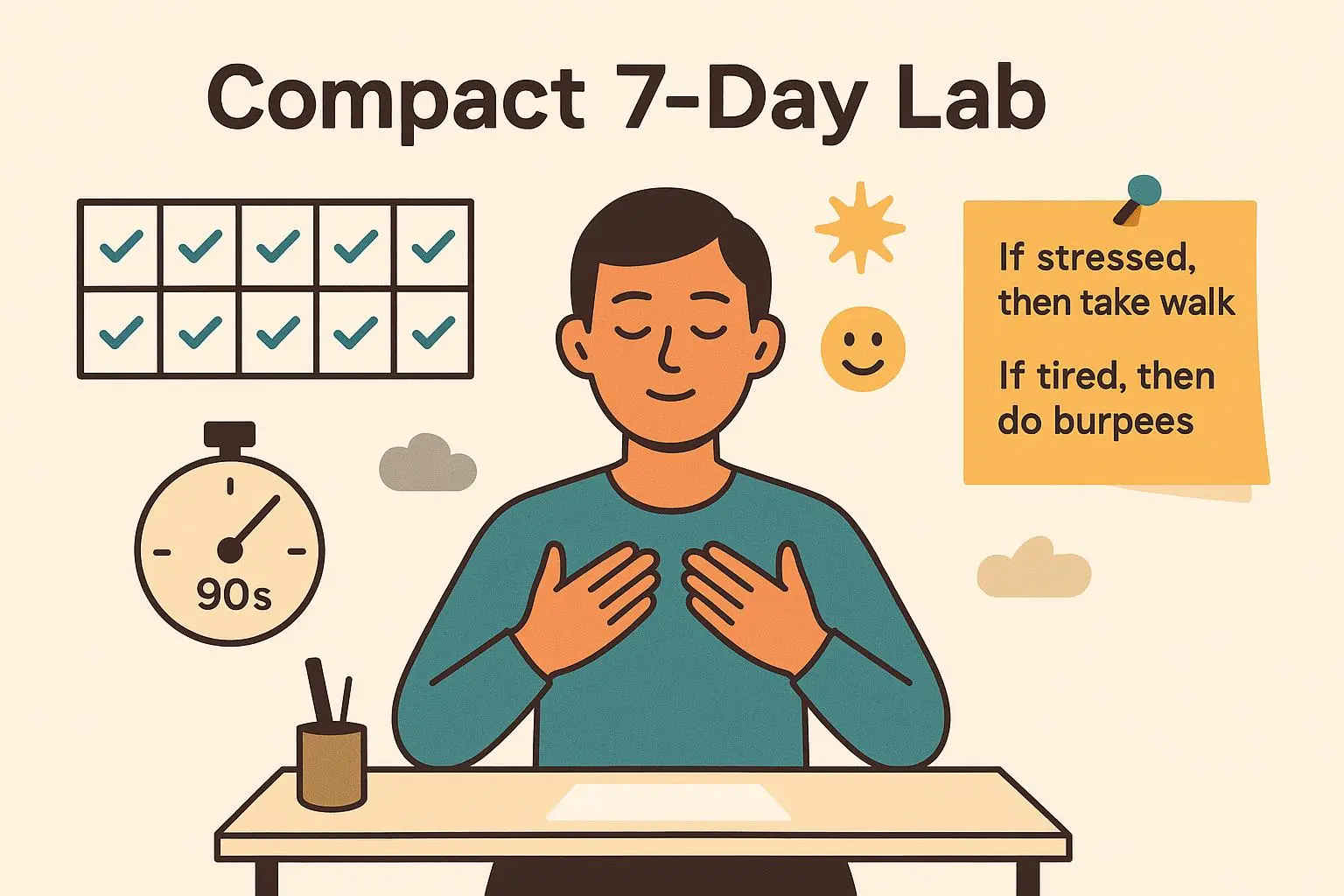
Here’s a different assumption: identities change when your brain collects steady, undeniable evidence that you already are the person you want to be. That’s what I mean by identity micro-rituals—60–120 second actions you can anchor to a daily cue. Do them long enough, and the brain stops arguing.
Below you’ll get eight ultra-specific rituals. For each: a one-line identity phrase, the exact micro-action, an anchor (where to attach it), and a 4-week scaling plan you can follow without feeling like you’ve been assigned extra life chores.
Quick aside: I tested these on a small group of friends and myself. The thing that surprised me wasn’t the habit itself—it was how quickly the mental friction dropped. One friend told me at week two, “I forgot I ever doubted this would stick.” That’s the point. Tiny action, big internal update.
Why 60–120 seconds works
Simple neuroscience and behavior science line up here.
- Small wins produce dopamine signals that reinforce repetition.
- Anchors (existing habits or environmental cues) make prompts automatic.
- Self-perception changes through behavior: act like a patient person enough times, and your inner narrative updates.
This isn’t magic. It’s low-friction social proof for your own identity. You’re not asking to become perfect—you’re building evidence.
Now let’s get specific.
1) The Disciplined Investor
- Identity phrase: “I am a disciplined investor who prioritizes long-term growth.”
- Micro-action (90 seconds): Open your brokerage app, look at your largest holding, then close the app without reacting—no trades, no panic-checking headlines.
- Anchor: Right after your morning coffee.
- 4-week scaling plan:
- Week 1: Do this once a day.
- Week 2: Morning and evening checks (same no-action rule).
- Week 3: Add a 30-second note: one sentence on why your largest holding belongs in your portfolio.
- Week 4: Increase the reflection to 60 seconds and log one tiny insight weekly.
Why this works: The act trains emotion regulation around money. You replace impulsive reactivity with a calm ritual that signals “I evaluate, not react.”
Micro-moment: I used to doom-scroll my portfolio at 7am. After two weeks of this ritual, the urge faded. Seeing the holding and closing the app became a small victory—like not eating dessert because you remembered you actually prefer fruit.
2) The Proactive Networker
- Identity phrase: “I am a connector who values professional relationships.”
- Micro-action (60 seconds): Open LinkedIn (or your preferred platform), pick one person you haven’t messaged in 6+ months, and send a short, genuine note—no asks. Example: “Saw this and thought of you—hope you’re well.”
- Anchor: Right before opening your primary work email.
- 4-week scaling plan:
- Week 1: One message per workday.
- Week 2: Two messages per workday.
- Week 3: Add a short follow-up to an older connection.
- Week 4: Schedule one 15-minute virtual coffee based on this outreach.
Why this works: Consistent small acts beat sporadic grand gestures. The ritual reframes your network as active, not dormant.
Real story (120 words): A few months ago I put this to work because my LinkedIn felt like a museum. Week 1: one message a day—mostly short check-ins. By week three, one of those check-ins turned into a 20-minute chat that led to a freelance gig. I didn’t land the client because I scheduled pitches; I landed them because I became someone who shows up. The shift wasn’t dramatic—just steady signals. That 60-second habit cost me less than a minute each morning and created conversation threads that eventually mattered.
3) The Focused Creator
- Identity phrase: “I am a creator who respects deep work blocks.”
- Micro-action (120 seconds): Open your main document or IDE, type a title or main header, then set a 25-minute timer. Don’t check notifications until it rings.
- Anchor: Immediately after sitting down at your workspace.
- 4-week scaling plan:
- Week 1: One 25-minute block daily.
- Week 2: Increase the block to 35 minutes.
- Week 3: Add a second 25-minute block later in the day.
- Week 4: Ensure the first block is completed notification-free.
Why this works: Starting is the hard part. Naming the work and committing to 25 minutes reduces decision fatigue and signals: creation is the default now.
4) The Health-Conscious Eater
- Identity phrase: “I am someone who fuels my body with high-quality nutrition.”
- Micro-action (60 seconds): Before eating, take one deep breath and name the healthiest item on your plate (e.g., “spinach” or “walnuts”).
- Anchor: As soon as your food is in front of you.
- 4-week scaling plan:
- Week 1: Do this for one main meal daily.
- Week 2: Expand to all meals.
- Week 3: Add a pre-meal glass of water.
- Week 4: Eat the healthiest item first.
Why this works: Naming what’s good creates mindful consumption. You don’t need to overhaul your diet—just designate one deliberate choice per meal.
5) The Consistent Learner
- Identity phrase: “I am a lifelong learner who seeks new knowledge daily.”
- Micro-action (75 seconds): Read one paragraph from a non-fiction book or an article you trust.
- Anchor: Right before bed.
- 4-week scaling plan:
- Week 1: One paragraph nightly.
- Week 2: Two paragraphs.
- Week 3: One full page.
- Week 4: One page plus one written takeaway before lights out.
Why this works: The ritual converts “I want to learn” from intention to evidence. Those tiny pages stack into real knowledge over months.
6) The Mindful Communicator
- Identity phrase: “I am a thoughtful person who listens before responding.”
- Micro-action (60 seconds): In conversation, pause for a full three seconds after the other person stops speaking before you reply.
- Anchor: The moment the other person finishes speaking.
- 4-week scaling plan:
- Week 1: Practice in three conversations.
- Week 2: Practice in five conversations.
- Week 3: Make it your default in most interactions.
- Week 4: Add a summarizing phrase: “So, if I understand you correctly…”
Why this works: The pause reduces reactive speech and creates space for accurate listening. It’s simple, oddly generous, and immediately noticeable to others.
7) The Organized Home Manager
- Identity phrase: “I respect my space and keep things tidy.”
- Micro-action (120 seconds): Pick up three out-of-place items in your main living area and return them where they belong.
- Anchor: Immediately upon walking in the door after work or errands.
- 4-week scaling plan:
- Week 1: Three items daily.
- Week 2: Five items daily.
- Week 3: Wipe one high-touch surface after pickup.
- Week 4: Daily five-item pickup plus a 60-second bed-to-bed reset.
Why this works: The small habit prevents clutter accumulation. It’s less about polish and more about reducing background friction in your life.
Quick micro-moment: I started this with two socks and a charger. Two days later, my living room actually looked like a room people could enter without apologizing. That tiny change made my Monday less heavy.
8) The Resilient Self-Talker
- Identity phrase: “I am resilient and view setbacks as data, not destiny.”
- Micro-action (60 seconds): When frustrated or after a mistake, say (aloud or inside): “That was a learning opportunity.”
- Anchor: The moment you notice negative emotion or error.
- 4-week scaling plan:
- Week 1: Say it after the first mistake each day.
- Week 2: Say it after every recognized mistake.
- Week 3: Try to catch the thought before it spirals and say it.
- Week 4: Put the phrase on a sticky note where you’ll see it often.
Why this works: Language reframes experience. Calling a misstep a learning opportunity is a cognitive re-route—you stop punishing and start extracting data.
How to make these stick (realistically)
- Pick two rituals to start. Don’t do all eight.
- Choose anchors that already exist—coffee, door entry, sitting at your desk.
- Use reminders for the first week only: an app, a sticky note, whatever works.
- If you miss a day, don’t agonize. The goal is momentum over perfection.
- Share progress with one person for accountability. Even one text a day changes behavior.
Here’s the honest truth I learned: small things feel silly at first. That’s okay. Silly is the gateway drug to sustainable change.
Common objections and what to do
- “I forget.” Use a visible anchor (phone wallpaper, coffee mug) for two weeks.
- “It’s embarrassing.” Do the ritual privately until it feels normal.
- “I don’t have time.” You do. This takes 60–120 seconds. Swallow that resistance once and the cost becomes obvious.
When micro-rituals won’t be enough
Micro-rituals are scaffolding. They help shift identity but won’t replace deliberate skill-building. If your goal is to run a marathon or become a senior engineer, pair micro-rituals with deliberate practice blocks and coaching.
The 4-week mindset
Think four weeks as a single experiment. The plan scales gently so you can test whether the ritual reduces friction or increases the identity signal you want. After four weeks, decide: stick, adjust, or drop. No moral failing if you pivot.
Tools that help
- Streaks or Productive for habit streaks.
- Notion for logging reflections and takeaways.
- Focusmate for accountability on the Focused Creator ritual.
Final note: start where you are, not where you wish you were
Identity change isn’t binary. It’s a series of votes you cast for who you want to be. These micro-rituals are low-cost votes—easy to execute, hard for your brain to ignore.
Pick two. Anchor them. Do the 4-week test. If you want, come back in 30 days and swap in new rituals. Over months, those votes accumulate, and one morning you’ll find yourself doing the thing without thinking—and your brain will quietly update the label.
Start with a minute. That minute is a proof point. Your future self will thank you.